

Pillars of Parliament
POP Principles of Parliament
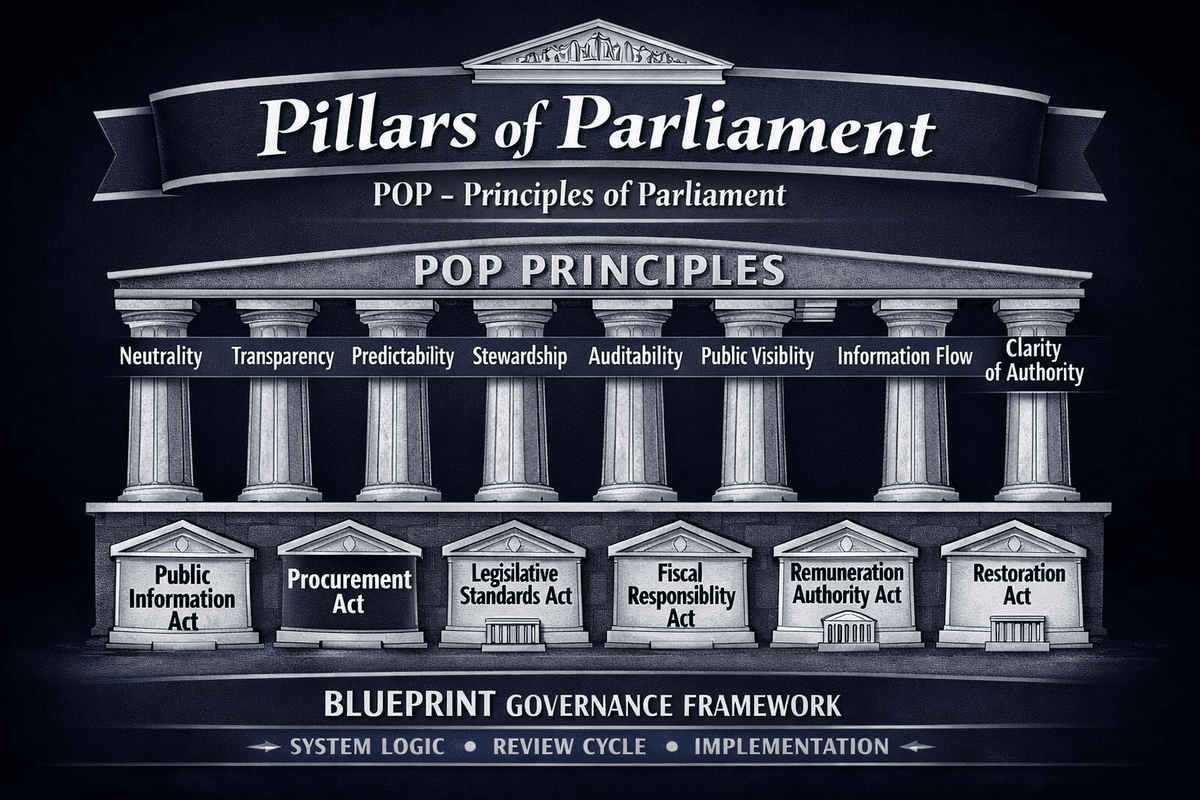
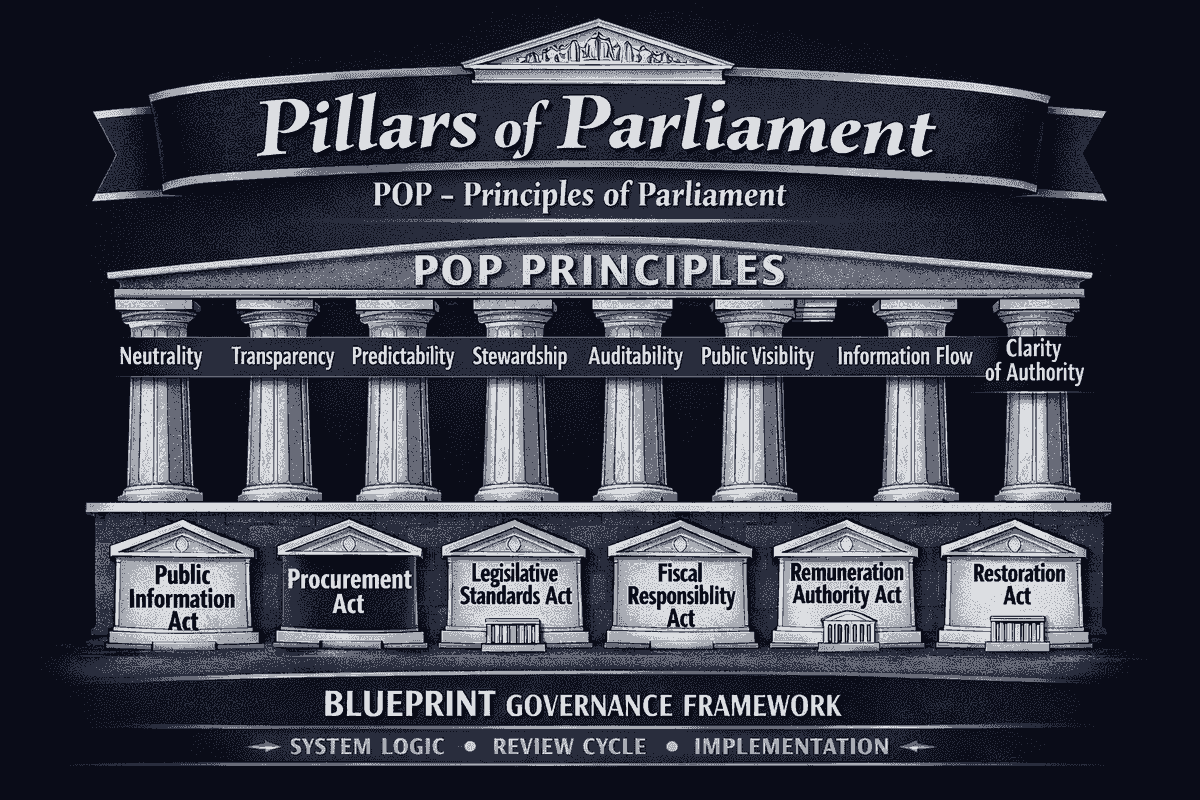
Pillars of Parliament (POP) defines how Parliament should behave
the cultural and ethical framework that sits above the legislative Acts and anchors the entire governance system.
Purpose
To define the cultural and structural foundations of Parliament — the behavioural, ethical, and operational principles that guide governance under the MOV ITx framework.
POP is the umbrella layer above the Acts.It sets the tone, expectations, and stewardship standards for how Parliament behaves, communicates, and governs.
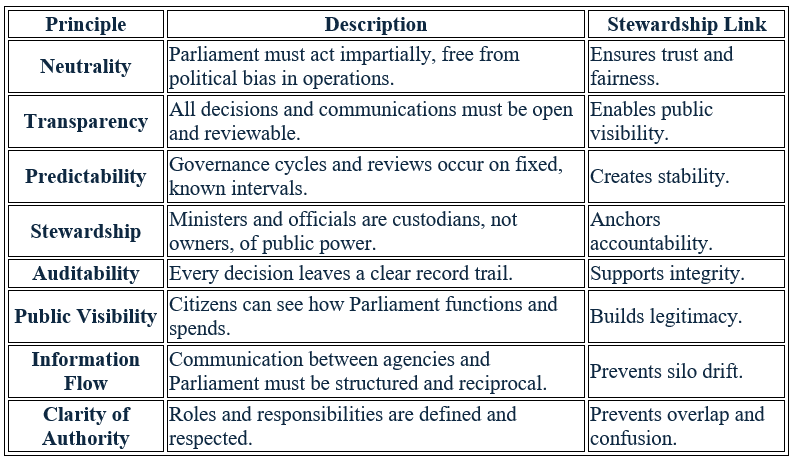
Core Principles
Overview of the MOV ITx Governance Framework — six core Acts forming the pillars of parliamentary oversight and blueprint design.
Structural Relationship
POP sits above the Acts as the cultural framework.
- POP = Principles
- Pillars = Acts
- Blueprint = System logic and implementation
Together, they form the Governance Architecture Stack.
Governance Integration
POP principles are embedded into:
- Legislative drafting standards
- Procurement and operations rules
- Ministerial stewardship codes
- Public communications protocols
- 12‑month review cycles
MOV ITx Governance Framework
Acts & Blueprints Currently Under Development
Public Information Act
Governs official communications and public transparency under the Parliamentary Communications Authority. Publication protocols in development.
Procurement Act
Establishes transparent procurement standards and oversight for public spending. Framework content under development.
Legislative Standards Act
Sets ethical and procedural standards for lawmaking and governance. Draft principles being refined.
Fiscal Responsibility Act
Defines fiscal sign‑off and accountability for expenditure approvals. Detailed governance model in progress.
Remuneration Authority Act
Regulates pay structures and fairness across public service roles. Implementation guidelines forthcoming.
Restoration Act
Defines the restoration and adequacy framework for resolving historic and systemic harms. Core blueprint architecture is currently under development.
The Restoration Act provides the overarching framework for restoring individuals to their rightful position had harm not occurred; Project Kōtare embodies this framework, incorporating one application alongside a broader system design for a defined population affected by a specific systemic failure.

How POP Future‑Proofs New Zealand
Building the accountability architecture our growing nation now needs
New Zealand has changed dramatically in a single generation.We grew from just over 3 million people to more than 5 million, with higher migration, more diversity, and far more complex social needs. But our governance systems stayed almost exactly the same as they were in the 1980s.
POP is designed to close that gap.
It gives New Zealand the structural guardian we never built during our rapid growth — a framework that protects fairness, transparency, and trust as the country continues to evolve.
1. POP scales with population growth
New Zealand’s old “high‑trust, low‑oversight” model worked when the country was small and simple.It cannot carry a population of 5–7 million.
POP replaces personality‑based trust with system‑based integrity:
- verified presence
- standardised leave
- clear performance rules
- automatic consequences
- public reporting
This means the system stays stable even as the population grows.
2. POP separates politics from governance
As New Zealand grew, political parties quietly expanded their taxpayer‑funded staffing and communications operations. POP stops this permanently by tying staffing to constitutional function, not party power.
- No political staff funded by taxpayers
- No oversized Opposition or Ministerial offices
- No blurred lines between campaigning and governing
This protects the neutrality of the public service for future generations.
3. POP locks in visibility as a permanent feature
For decades, MP presence, leave, and performance were invisible.POP makes visibility non‑negotiable.
- verified presence
- transparent leave
- public dashboards
- standardised reporting
- the POP integrity symbol marking official information
Future governments cannot quietly remove transparency once it is built into the system.
4. POP protects taxpayers from budget creep
Without structural limits, political offices naturally expand over time. POP stops this cycle by:
- defining staffing entitlements
- removing political comms teams
- preventing shadow‑government structures
- linking entitlements to verified performance
This keeps the system lean, fair, and sustainable.
5. POP stabilises trust in a social‑media world
Social media amplifies misinformation, outrage, and political noise. POP provides a counterweight:
- a neutral guardian
- verified data
- consistent rules
- a symbol that marks trustworthy information
This helps protect New Zealand’s social cohesion as digital pressures grow.
6. POP strengthens the whole state, not just Parliament
Once POP is in place, the same logic can be extended to:
- agencies
- Crown entities
- local government
- health, housing, and justice systems
POP becomes the template for modern, transparent public administration.
7. POP preserves what New Zealand values most
New Zealand’s identity has always been built on:
- fairness
- trust
- community
- responsibility
- looking after one another
POP doesn’t replace those values — it protects them.
It ensures that as the country grows, the integrity of public office grows with it.
New Zealand nearly doubled its population in one generation — but kept the same governance architecture. POP is the structural upgrade that brings accountability, visibility, and fairness into alignment with the country we’ve become.